
Quality inspection that never leaves your factory.
Trained only on your conforming parts, our AI detects defects in a fraction of a second and logs every decision, for flawless quality and data that stays safe.
Demo, or validation on your images: results in a few days, no commitment.
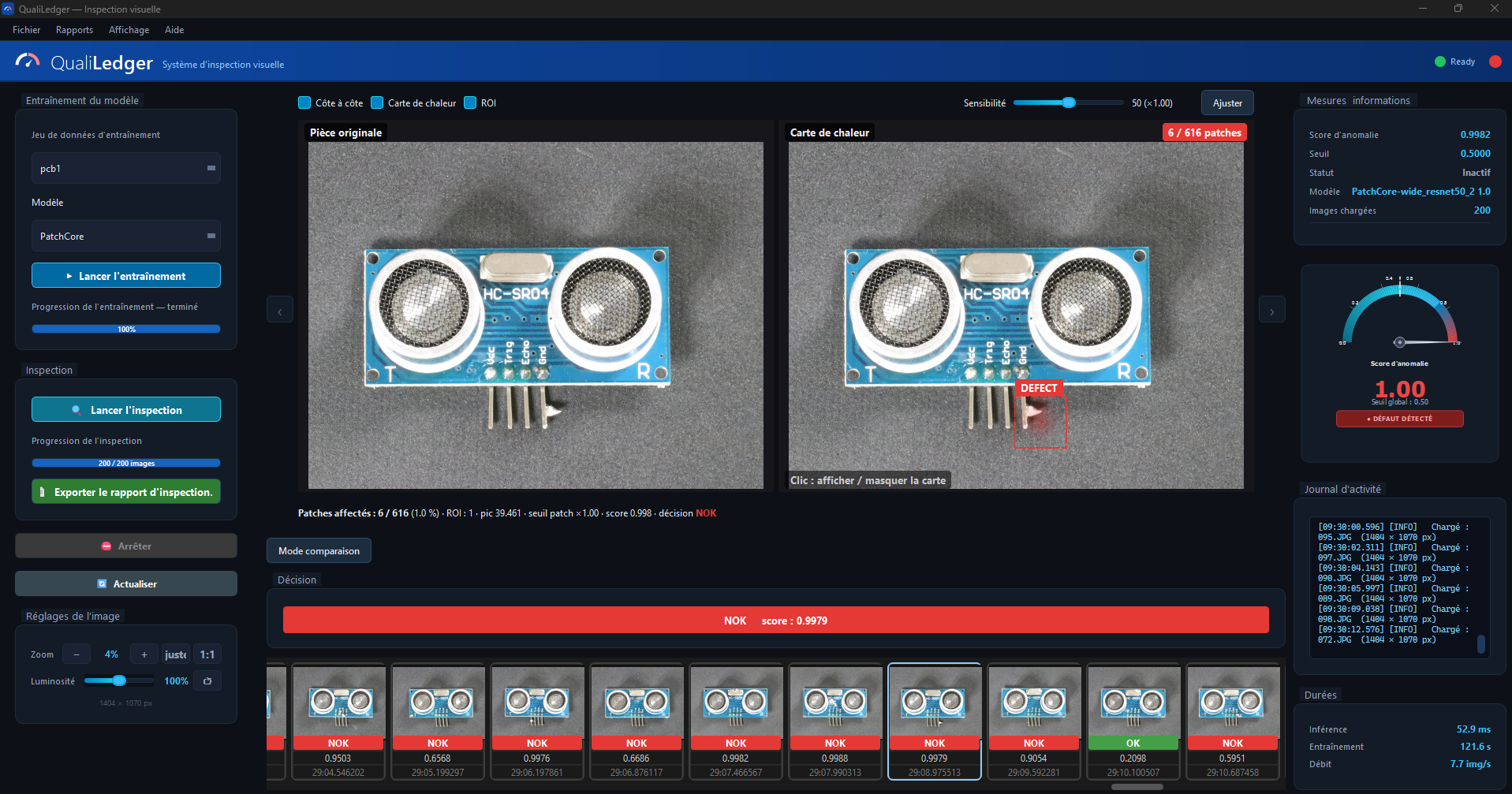
Images: VisA (Zou et al., ECCV 2022), CC BY 4.0.
Support with AI funding schemes: how we help you →
What you gain with QualiLedger
Six concrete gains for your quality control, from the first image to the audit.
You start without collecting defects
All you need is at least 100 images of your conforming parts, with no labeling. No more waiting for rare defects to train a model.
You also catch the unknown
A defect never seen before is flagged as a deviation and located on the image, with no retraining.
You keep your data in-house
100% on-premise, offline, compatible with an air-gapped network. No image ever leaves your factory.
You limit false rejects
Borderline cases go to an operator, with the score and the heatmap. You keep the final decision.
You are ready for your audits
Every correction and validation is attributed to an operator, in an exportable audit log where any change is detectable.
You switch product references on your own
New reference or new lighting: you retrain in a few minutes, with no data scientist or vendor involved.
What would you gain on your parts? The free validation measures it on your own images, with your results in a few days and no commitment.
Test on my imagesIn France, we also help you put together your AI funding application. See our support →
Why choose QualiLedger?
Rare defects can’t be collected. QualiLedger learns from your conforming parts and flags anything that deviates from them, with a heatmap that shows where.
| Criterion | Supervised model | QualiLedger |
|---|---|---|
| Training images | Hundreds of defect images, to collect and label | Your conforming parts only |
| Never-seen defect | Often missed until it is retrained | Flagged as a deviation, with a heatmap |
| Product reference change | New data collection, new training | Autonomous retraining in a few minutes |
| Your images | Sometimes sent to an external service | They stay in the factory |
| Decisions | Rarely traced | Corrected, validated and attributed to an operator |
How it works
What QualiLedger does, in three steps to production.
You show your conforming parts
Provide at least 100 images of your good parts. No defects to collect or label.
- Guided trainingImport your conforming images and follow progress, with a stop button.
The AI inspects every part automatically
Each part is analyzed in a fraction of a second. Any deviation is flagged and located on the image.
- Batch inspectionOpen an image or a whole folder and browse the results as thumbnails.
- Three-level verdictA readable score and a threshold. The gray zone goes to an operator.
- Operator controlThe operator corrects, validates and approves under their own identity.
Every decision is kept
Result, score, validations and corrections are archived in an audit log protected by cryptographic fingerprints: any change becomes detectable. Reliable evidence for your audits, your customers and your certifications.
- Audit reportsDaily or custom report, exported in a few clicks.
- MonitoringReal-time defect rate and service status, even on a second screen.
An interface built for the shop floor
Zoom, pan, brightness adjustment and keyboard shortcuts: the operator examines the defect without third-party software and can overturn a doubtful decision.
Your industrial data stays in your factory.
QualiLedger installs in your own infrastructure. No image is sent to an external service.
- 100% on-premise deployment, compatible with an air-gapped network
- Mandatory operator identification for every traced action
- History of corrections and approvals
How we support you
In France, public schemes help SMEs and mid-sized companies adopt AI, such as IA Booster France 2030, operated by Bpifrance. We help you build and present your project.
We scope your needs
Line, defect types, throughput, inspection stations: together we define the solution that fits your company.
We prepare the technical file
Solution, architecture, use cases, expected gains and a detailed quote. A single file, usable for all your applications.
We point you to the right contacts
Your regional Bpifrance advisor or your local chamber of commerce (CCI) reviews the project with you. You stay in charge of your application.
We deploy on site
Pilot on your parts, validation, then go-live, with training for your teams.
Eligibility and the level of funding depend on your situation and are decided by the relevant bodies.
FAQ for vision integrators
How does the application integrate with my production line and cameras?
The desktop application loads the images produced by your industrial cameras (files or folders) and sends them to the local inference engine. The verdict (OK, Doubtful or Defect), the anomaly score and the heatmap are returned immediately. Direct connection to your supervision system, your PLC or your cameras is defined with you during a demo.
How many conforming images are needed, and what hardware is required?
You need at least 100 images of conforming parts, with no defect collection or labeling. The engine runs in a Docker container on a workstation or server at your site, equipped with a GPU. Tested configuration: NVIDIA GeForce RTX 5060 Ti (16 GB).
Does performance change from one product to another?
Yes, it depends on the part, the type of defect and the image acquisition conditions (lighting, framing). We do not promise a single rate for all products: detection accuracy above 97% is measured on the public VisA dataset. The free validation on your own images measures the result on your parts, before any commitment.
What happens if my parts, lighting or process change?
You stay in control. For a new reference or a change in acquisition conditions, you retrain the model from the application with new conforming images, without going through a vendor or a data scientist. Training takes a few minutes depending on the number of images. Each reference (dataset) keeps its own history of models and inspections, and previous model versions remain stored.
How do I limit false rejects without letting defects through?
The decision threshold is calibrated automatically at training time, from your conforming images. The “Doubtful” verdict isolates borderline cases: the operator reviews them with the score and the heatmap, which show why a part is flagged, then decides, and the decision is logged. Every inspection is recorded with its score and threshold. To refine the model, retrain it with more conforming images.
Book a personalized demo or a free validation
Two ways to start, with no commitment: a demonstration, or a free validation phase on your own images, with results in a few days. Tell us what you inspect: we reply within 2 business days.